Judgment Metrics for AI-Augmented Teams
Move beyond tokens and lines of code. Measure how effectively your people evaluate, govern, and improve AI-assisted work.
- Align AI experiments with real business risk, not vanity metrics.
- Track evaluative throughput and judgment quality across teams.
- Designed for engineering, consulting, support, HR, legal, and finance leaders.
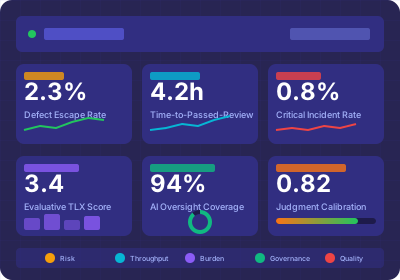
Why "Judgment Metrics" instead of productivity metrics?
AI has made it cheap to generate code, content, and decisions at scale. The bottleneck is no longer producing artifacts, but evaluating them: deciding what is correct, safe, compliant, and aligned with your strategy.
Traditional productivity dashboards focus on volume metrics like tokens, prompts, lines of code, or tickets closed. In AI-heavy workflows these numbers go up automatically, even when quality, risk, and human judgment are deteriorating.
Judgment metrics re-center the scoreboard on what actually matters: whether your teams can reliably oversee AI, catch issues before they escape, and make sound decisions under pressure.
Anchor to Risk
Anchor AI performance to human judgment and risk, not just throughput.
Detect Drift
Detect when AI is silently increasing error rates or cognitive load.
Common Language
Give leaders a shared vocabulary to compare AI experiments across teams.
Core Idea
AI commoditizes generation. Human judgment becomes the scarce, critical resource. Your metrics should reflect that.
The Judgment Metrics Framework: Five Pillars
Together, these pillars describe how well your organization is handling AI-assisted work: not just how much you produce, but how safely and sustainably you do it.
Evaluative Throughput
How much review and decision work your experts can process per unit time without quality collapse.
Judgment Quality
How often those decisions are correct, robust, and aligned with policy, context, and ethics.
Risk & Defect Dynamics
Where errors surface across the lifecycle and how severe they are when they escape into production or to customers.
Evaluative Burden
How demanding it is for humans to provide reliable oversight over AI-assisted work, and how that affects fatigue and burnout.
Governance & Behavior
Whether people actually follow the intended "human in the loop" process and guardrails when AI is involved.
Key Metrics at a Glance
The full playbook provides a larger metric library. Here we highlight a core set that any AI-augmented organization can start with.
Defect Escape Rate (DER)
Risk & Defect DynamicsHow many issues are discovered only after an artifact is approved or deployed.
DER = post_approval_defects / total_defectsCritical Incident Rate (CIR)
Risk & Defect DynamicsFrequency of high-severity failures per unit of output.
CIR = high_severity_incidents / total_artifactsTime-to-Passed-Review (TTPR)
Evaluative ThroughputTime from first submission of an artifact to final sign-off.
TTPR = time_passed_review - time_first_submissionReview Iteration Count (RIC)
Evaluative ThroughputHow many review–revision cycles are needed before acceptance.
RIC = number_of_review_cyclesOversight Challenge Pass Rate (OCPR)
Judgment QualityHow often reviewers catch intentionally seeded issues in AI-assisted work.
OCPR = seeded_issues_caught / total_seeded_issuesJudgment Calibration Index (JCI)
Judgment QualityAlignment between reviewer confidence and actual correctness.
Compare confidence ratings to audit outcomes on sampled decisions.Evaluative NASA-TLX (eTLX)
Evaluative BurdenSelf-reported mental workload of oversight tasks, using a TLX-derived mini survey.
Average score across mental demand, temporal demand, effort, and frustration.Review Latency (RL)
Evaluative BurdenHow long artifacts wait in queue before substantive review starts.
RL = review_start_time - artifact_ready_timeAI Oversight Coverage (AOC)
Governance & BehaviorShare of AI-involved artifacts that passed through the required human review gate.
AOC = reviewed_AI_artifacts / total_AI_artifactsBypass / Override Rate (BOR)
Governance & BehaviorHow often people bypass safeguards or override AI without proper justification.
BOR = unlogged_bypasses / total_decisionsMetric Bundles by Role and Function
Different teams experience AI very differently. The playbook provides tailored metric bundles for each type of knowledge work.
Software Engineering & Data Science
Measure whether AI coding tools are improving throughput without increasing risk.
- Time-to-Passed-Review (TTPR) per pull request
- Defect Escape Rate (DER) for AI-assisted vs non-AI code
- Critical Incident Rate (CIR) for production incidents
- Oversight Challenge Pass Rate (OCPR) on seeded bugs
- Evaluative NASA-TLX (eTLX) for reviewers
Consulting, Product & Strategy
Ensure AI-drafted content and analysis improve speed without degrading decision quality.
- TTPR for client-facing documents and internal memos
- Review Iteration Count (RIC) per deliverable
- Defect Escape Rate (DER) for issues raised by clients or senior reviewers
- Judgment Calibration Index (JCI) on key recommendations
- AI Oversight Coverage (AOC) for AI-assisted analyses
Customer Support & Operations
Track AI-assisted responses and workflow changes for both efficiency and quality.
- Ticket resolution time and TTPR for knowledge base updates
- Defect Escape Rate (DER) as ticket re-open rates
- Critical Incident Rate (CIR) for severe mishandling cases
- Escalation Quality Rate (EQR) for triage decisions
- AI Oversight Coverage (AOC) in high-risk categories
HR, Legal, Compliance & Finance
Protect high-stakes decisions while using AI to accelerate drafting and analysis.
- Defect Escape Rate (DER) from internal and external audits
- Critical Incident Rate (CIR) for legal or regulatory events
- Approval Overturn Rate (AOR) for major decisions
- Rubric adherence checks (via OCPR-style audits)
- Bypass / Override Rate (BOR) and AI Oversight Coverage (AOC)
Implementation Roadmap
You do not need to instrument everything at once. The playbook is designed to be rolled out in one or two functions first, then scaled across the organization.
Choose judgment-critical workflows
Map tasks using the error-cost × tacitness 2×2. Start with "Quality Control" and "Human-first" workflows where humans must remain accountable, but AI is already present.
- •Examples: production deploy approvals, high-value client deliverables, HR or compensation decisions, compliance reporting.
- •Avoid starting with the simplest tasks; those rarely reveal judgment failures.
Define the unit of evaluation
Specify what counts as an artifact, review, and approval for each workflow.
- •Artifacts: pull requests, memos, contracts, support tickets, policy changes.
- •Events: first submission, review start, change requested, final sign-off.
Wire up data from existing tools
Use your current systems as telemetry sources rather than deploying new tools first.
- •Source TTPR, RIC, RL, and AOC from code review tools, ticket systems, or document platforms.
- •Link artifacts to defects or incidents to calculate DER and CIR.
- •Add a lightweight eTLX survey for reviewers during selected periods.
Baseline pre- or low-AI performance
Capture at least one cycle of "as-is" data before large-scale AI changes.
- •Use historical data where available, or temporarily reduce AI usage in a subset of work.
- •This is your reference point for evaluating AI interventions.
Run AI changes as experiments, not faith
For each AI rollout, define explicit hypotheses in terms of judgment metrics, then monitor them.
- •Example: "TTPR decreases by 20%, DER remains flat or decreases, CIR does not increase."
- •Set guardrail thresholds: if DER or CIR exceed agreed limits, pause or adjust the rollout.
Standardize dashboards and governance
Once stable patterns emerge, codify them into standard dashboards and operating rules.
- •Use bundles of metrics, not single targets, to avoid gaming.
- •Review judgment metrics regularly in leadership forums, alongside financial and operational KPIs.
How Judgment Metrics Connects to AI CogniFit
AI CogniFit is built around the same principle as this playbook: the main constraint in AI adoption is human judgment, not model performance.
Our Arena and assessment tools measure individual and team judgment under uncertainty. Our research standards page explains how we grade the evidence behind our recommendations.
This Judgment Metrics Playbook extends that philosophy into your day-to-day operations by giving you concrete, implementable metrics and dashboards.
Frequently Asked Questions
Download the Full Judgment Metrics Playbook
Get the detailed metric definitions, implementation guides, and role-specific dashboards as a ready-to-use PDF.
Download PDF